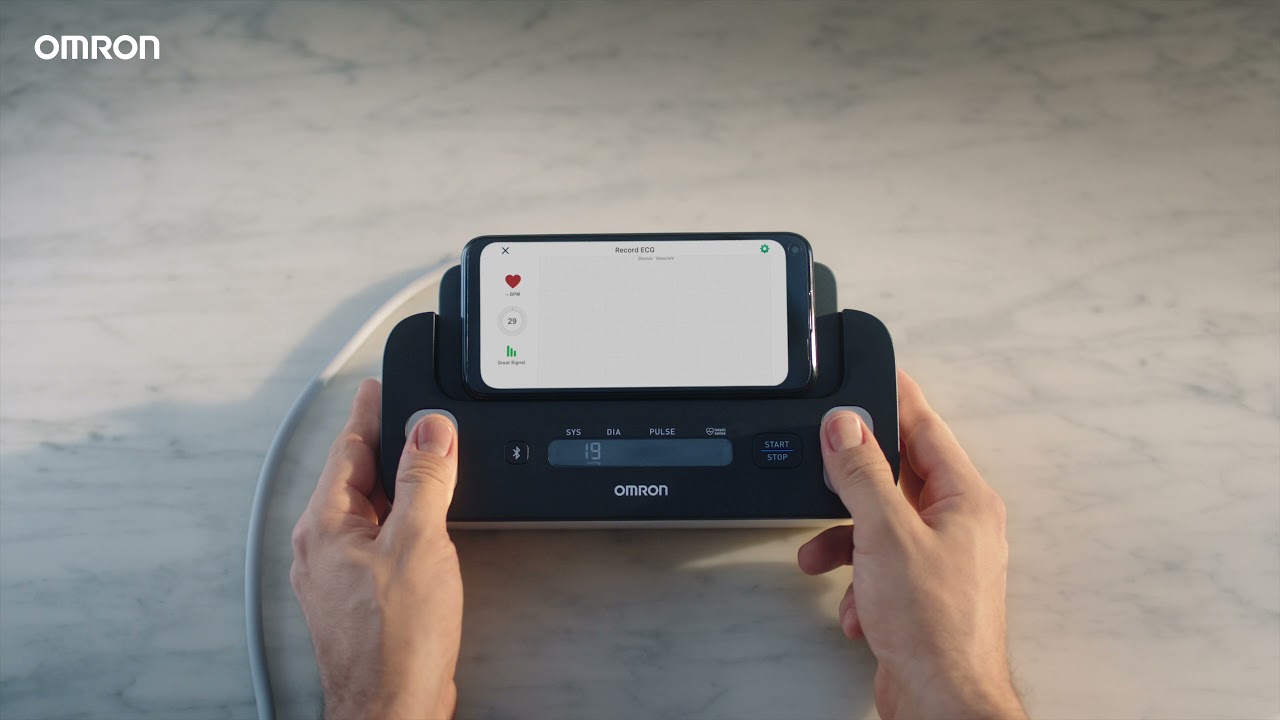
2 in 1 clinically validated blood pressure monitor with built in ECG to quickly screen for hypertension, AFib, tachycardia and bradycardia at home.

OMRON connect compatible
WARNING! BEWARE OF FAKE WEBSITES OR SOCIAL MEDIA ACCOUNTS SELLING COUNTERFEIT OMRON PRODUCTS
Unusual heartbeat?
Early diagnosis of atrial fibrillation is essential, as the risk increases with age. Its symptoms are often subtle or misleading, leaving many people undiagnosed.


2 in 1 clinically validated blood pressure monitor with built in ECG to quickly screen for hypertension, AFib, tachycardia and bradycardia at home.
Locate your nearest pharmacy and medical store where you can discover OMRON Complete and receive advice in person.
Blood pressure monitoring and home electrocardiogram (ECG) tracing play a crucial role in preventing strokes. They enable the early detection of irregular heart rhythms, allowing timely medical intervention and reducing the risk of stroke.
Early diagnosis, better outcomes
Identifying the signs of atrial fibrillation early at home, and acting promptly and effectively, can help prevent more serious complications.
Knowing when to seek help
Home ECG monitoring provides reliable readings that indicate whether an irregular heart rhythm is present.
Improving the doctor’s insight
Reliable, consistent data from home monitoring helps clinicians tailor treatment strategies more effectively.
Post‑procedure reassurance
Home ECG monitoring supports you in tracking your recovery after surgery.
Blood pressure monitoring and home ECG recording play a crucial role in stroke prevention. By identifying an irregular heart rhythm at an early stage and enabling timely medical intervention, the risk of stroke can be reduced.
Atrial fibrillation often occurs without symptoms and may go undetected during regular check-ups - this is why regular home screening is essential.


2 in 1 clinically validated blood pressure monitor with built in ECG to quickly screen for hypertension, AFib, tachycardia and bradycardia at home.

Important
Electrocardiogram tracing is an effective test to check the condition of the heart, but it does not capture all changes and symptoms of the heart. If the results of the tracing analysis show 'normal sinus rhythm' but symptoms persist, or if 'Unable to classify' or 'Unable to analyse' is displayed repeatedly, consult your doctor. Self-judgement and treatment based on analysis results are dangerous. Do not judge recorded results (electrocardiogram waveform) or displayed messages by yourself, always consult a doctor. Self-judgement based on analysis results may lead to worsening of symptoms.
References:
1.NHS. Home. Health A to Z. Atrial fibrillation. Available at: https://www.nhs.uk/conditions/atrial-fibrillation/. Accessed in May 2023.
2.European Society of Cardiology. The ESC. ESC Press Office. Press releases. Available at: https://www.escardio.org/The-ESC/Press-Office/Press-releases/Atrial-fibrillation-set-to-affect-more-than-14-million-over-65s-in-the-EU-by-2060#:~:text=Atrial%20fibrillation%20is%20the%20most,are%20caused%20by%20atrial%20fibrilation. Accessed in May 2023.
3.Staerk, L., et al. (2017). Atrial Fibrillation: Epidemiology, Pathophysiology, and Clinical Outcomes. Circulation research, [online] 120(9), pp.1501-1517. doi: https://doi.org/10.1161/CIRCRESAHA.117.309732.
4.Lloyd-Jones DM et al. Lifetime risk for development of atrial fibrillation: the Framingham Heart Study. Circulation. 2004 Aug 31;110(9):1042-6.
5.NHS. Home. Health A to Z. Atrial fibrillation. Available at: https://www.nhs.uk/conditions/atrial-fibrillation/complications/. Accessed in May 2023.
6.Verdecchia, P., et al. (2018). Hypertension and Atrial Fibrillation: Doubts and Certainties From Basic and Clinical Studies. Circulation research, [online] 122(2), pp.352-368. doi: https://doi.org/10.1161/CIRCRESAHA.117.311402.
OHEAPP-457